
AI governanceHuman augmentation
Govern the build. Augment the human.
Govern, map, measure and manage, with the evidence produced by the work itself rather than assembled afterwards for an audit.
Built by TEKIMAX, and used on the client software we deliver.
Membership is not an endorsement.

Do more with the time you have
Humans working with AI finish more work, faster, and to a higher standard. The time it frees goes to judgement and the bigger picture.

Stay answerable for every action
A tamper-evident record of what happened, and a named person who can stop anything irreversible. Every framework asks for those two.
Connects to the apps the work already lives in
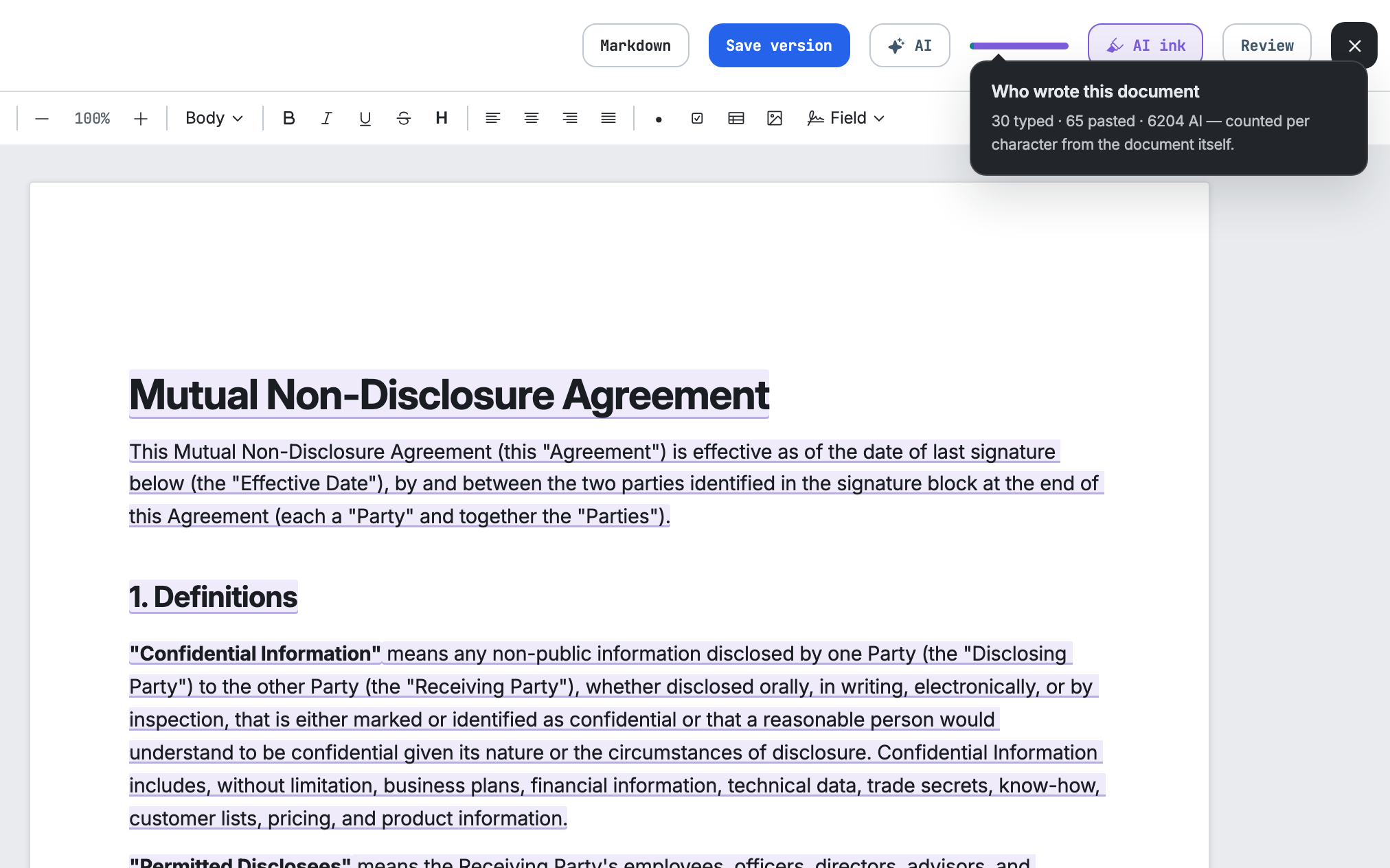
Nothing here runs until a person says so, and the decision is written down with their reason, on the same record as the work.
Responsible AI at work
Augment humans. Govern every action and record.
AI at work is for humans to get more done, not to be replaced. That holds only if every action an AI agent takes is one somebody answers for, and every piece of data it touches is handled on terms you set. Both are recorded as the work happens.
 CollaborationEvery action
is taken by a named AI agent or a named human, in the same place and on the same record. The work is shared rather than handed over, so credit and responsibility are never a guess.
 GovernanceNo exceptions
Deploying, merging and publishing stop before they run and wait for a named person. Reversible work runs without waiting for anyone. Who decided, and why, is kept beside the action.
 AugmentationMore done
by the same humans, because the machine takes the volume and the person keeps the judgement. The time it frees goes to the bigger picture, and nobody is replaced to pay for it.
ALOS brings the work together: humans, AI agents and workflows in one collaborative workspace.
humans
AI agents
Nothing here runs until a person says so, and the decision is written down with their reason, on the same record as the work.
workflows
Integrations
Works with the tools your team already uses
What you can do
Two rules, and the rest follows

Everything is written down
Every action is taken by a named AI agent or a named human, on one sealed record, so a later edit would show and nobody has to trust a summary.

Nothing here runs until a person says so, and the decision is written down with their reason, on the same record as the work.
Nothing goes live on its own
AI proposes. Deploying, merging and publishing wait for a named person, on the same record as the work. Reversible steps never wait.
What you can point at
Anything irreversible waits
Each step's kind is decided in advance, from a written list. Reversible work runs; work that cannot be undone stops and asks a person by name.
- Deploying, merging, publishing, sending something to a customer and changing how data is stored wait for a named person
- The approval sits beside the work it approved
- A refusal is recorded as carefully as a yes

Stopped before it ran, and waiting on a person by name.
An audit trail, for organisations that need one
The record is the product, not a report generated afterwards. It is written as the work happens and sealed as it lands.
- Who changed this, and when
- Which model was used, and what it was allowed to do
- A later edit to the record would show
- Tasks, client reports and the tools you connect all draw from it too

Every line names who acted, and the person whose authority they used.
Only what you approved
Your project runs on a list you agree to: the models, the packages, the tools. Anything not on it has to be asked for.
- Checked when it is used, not promised in a policy
- A complete parts list, with versions and licences

An example of one run, not a measurement of ours.
The features
One feature, one page, one job
- ApprovalsAnything that cannot be undone waits for a named person.Read the page
- Audit trail and evidenceWho did what, on a sealed record, exported when someone asks.Read the page
- Client portalDocuments, signing, progress, invoices and tickets, in one place.Read the page
- Scans and approved packagesApproved packages at the exact version, checked when used.Read the page
- AI agents and their workGive an AI agent a job, then read back every step of it.Read the page
- MCP serverConnect any AI agent, and the rules come with it.Read the page
The humans
Train the humans who run your AI agents
AI Solutions Specialist is a registered apprenticeship, and apprentices learn it by doing real work on real projects beside a mentor. They move on by showing what they can do rather than by serving out the months, and their hours and their sign-offs land on the same record as the work.
AI Solutions Specialist
Competency-based


Who we are
Who we are, and what we are for
TEKIMAX is a Fort Worth software company that builds AI systems for teams who answer for their work. The machine can now do real work, and most tools built around it take the person out of the loop. Then nobody is answerable, and capability without accountability is not progress.
Our mission is augmenting human performance, and it was long before this technology arrived. Not AI replacing a person, nor a person supervising a machine, but the two fitted so each does what it is best at. The idea was argued in 1960 and built on for decades since, and we build in that tradition.
The obvious objection is that a person in the loop is a bottleneck. It is, if you put one on every step, so we do not. Reversible work runs without waiting; only what cannot be undone stops for a named person. A team gets bigger work done, not smaller, and can show who decided what a year later.
Which way in
Three ways in, three kinds of buyer
The same platform, described three ways, because the person who signs for it is a different person each time.
 Forward-deployed engineeringAgencies and delivery teams whose client work has to have names on it when it is handed over.Open
 GovernanceGovern what may run, map what did, measure it on a sealed record, and manage what cannot be undone.Open
 An AI management systemFor a company running AI agents that is not a software company, and for the developers in the ones that are.Open
What it costs
Governance is not the expensive tier
The rules, the record and the approvals are in every plan. What changes is who it is for and how much of it you run, so what it costs depends on the work. Tell us what you are building and we will tell you.
Proof and questions
The things humans ask first
Is this a black box with a report on the front?
No. You can look inside it at any point: what is being made, what it is made from, who signed for each step, and where it stops if something is wrong. Each step's kind is decided in advance, from a written list, checked against your rules, and written down.
Who owns what you build?
You do. The solution is yours, and so is the source, the parts list, and the record of what was built and approved. Take all of it to another firm and they can carry on. The platform we build it with stays ours: you are paying for a solution, not a subscription.
What happens to our prompts and our code?
The model providers we send your work to are set to keep none of it, for every organisation, automatically, and what we store is deleted on a set schedule. It is how an account is built, not a switch somebody has to remember. Bring your own provider key and that key runs on your own contract with them, which is worth knowing rather than assuming.
Can we bring our own models?
Yes. A project runs on a list of models you agree to, and that list can be your own provider keys, or a model running on your own machines. What does not change is that the choice is written down and checked when a model is used.
Who is this a good fit for?
Any organisation that has to govern what its AI may do, measure what it did, and show a board or an auditor how its software was built and what is inside it.

Govern the build. Augment the human.
Tell us what you are building and who asks you about it. We will show you the record it would leave behind.
What you can answer afterwards
- Who did each piece of work, a named AI agent or a named human
- Which models were allowed on it, and which one ran
- Who approved the release
- What is in the software, down to each component and licence
- What happens to the work if you leave