Your client sees the work itself.
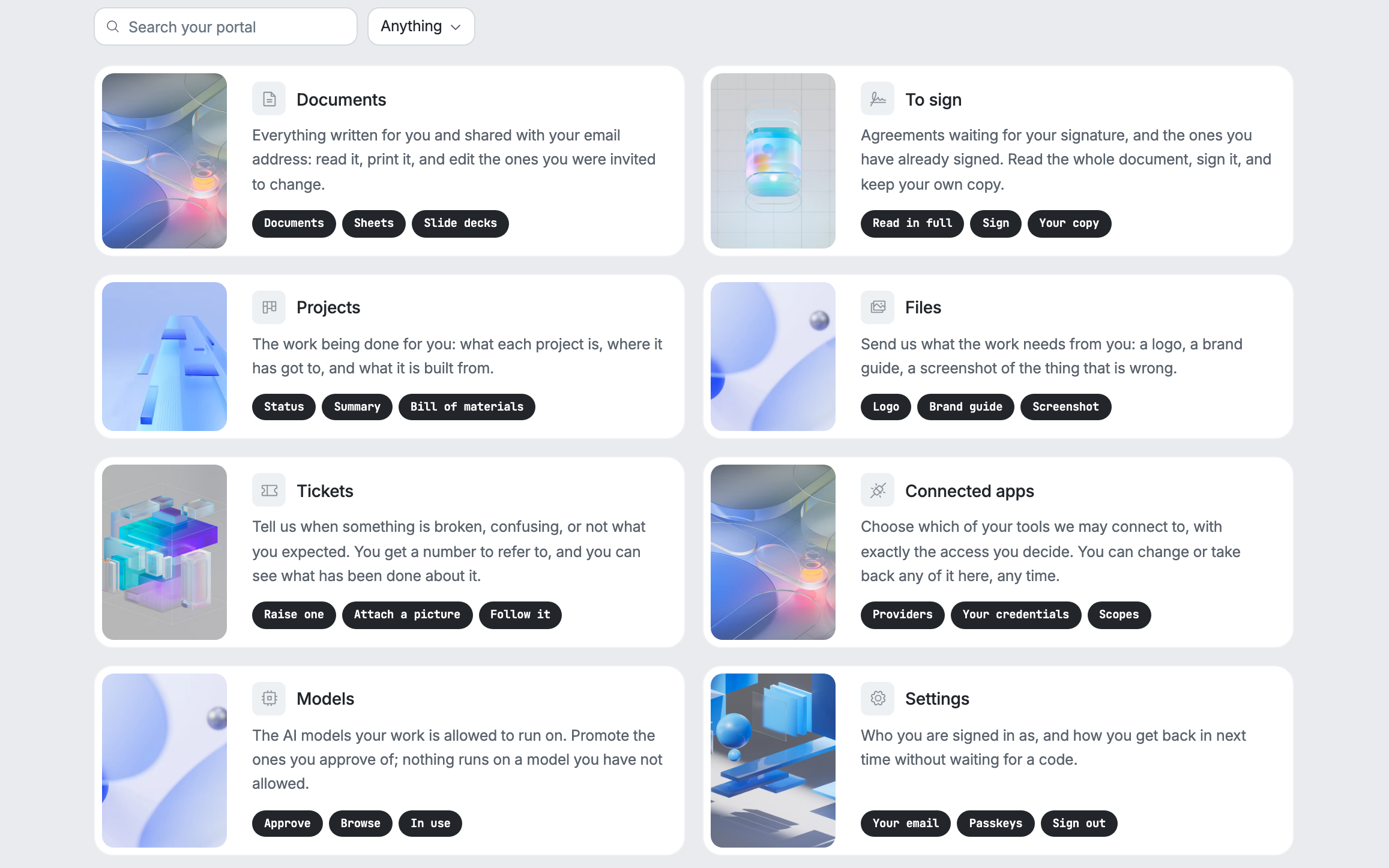
Your client opens one link and finds the whole engagement in one place: what you have shared, what is waiting for their signature, how the work is going, the invoices if you bill through us, and somewhere to send you files or raise a problem. You choose who gets in, one human at a time, and closing it takes the whole portal away at once.
Invite their team, each with a role
Invite your client's team the way you would invite a colleague. They sign in with the email you invited them by and a code sent to it, so nobody makes a separate account and nobody has a password to lose. Each human is invited with a role that says what they can do, and what each one can see is set per human, so two humans on the same team need not see the same things. Managing the connected tools is one of the things their role lets them do, which is why they can switch that access off themselves. Taking access back closes the whole portal at once.
Documents: the statement of work and what follows it
This is where the engagement's own papers live: the statement of work, the requirements the delivery is measured against, and the documentation your team writes as the work goes. It is one place and it is searchable, and the tickets your client raises sit with the work they are about. They can leave a comment next to the exact line it is about and get an answer from a named human on your team. Give them editing access and they are in the same live document as you, not a copy somebody emailed last week.

Signing, in the portal, not on someone else's site
Send an agreement out for signature and your client signs it where the rest of the engagement already is. Once it goes out it is locked, so nothing changes under the signer. You can see at a glance who has signed and who has not.
- What a client sees on each one: To sign, Read, not signed, Signed, Declined.
- A request can be pulled back from anyone who has not signed yet. A signature already made cannot be unmade.
- It is a simple electronic signature. It does not check anybody's ID.

Projects
Instead of asking you where things stand, your client can look. The project page carries what is moving now and who is on it, the latest update, how much is open, and a versioned list of what the software is built from. If you bill through us, the invoices sit on that same page with what is still owed and a link to pay; if you do not, none of that appears. An update can be a short video or a spoken briefing rather than a paragraph, which is often the faster way to say it.
They can just ask how it is going
A client who does not want to read four pages can type the question, or say it out loud, and get an answer. It answers only from what that particular human has been given, so it cannot tell them something they were not meant to see.
Connect the tools you already use
Your client connects their own account for the tools their team already works in. We never hold their password or their keys. The connection is theirs, so they decide what we can reach for the whole engagement, and they can switch it off whenever they like. It stops straight away.
Tickets
Three questions raise one: what kind of thing it is, one line about it, and the details, with a screenshot if that helps. They pick from a question, something is broken, please change something, or I cannot get in. Each one gets a reference your client can quote back, and a ticket can be withdrawn but never deleted.

See a portal set up for one of your clients.