
Only packages you approved, checked when used.
Your AI agents build with the packages you approved, at the versions you approved. Anything else, they have to ask for, and the ask is assigned to a human with the public security advisories already on it. Nothing ships on a scan nobody read.

An example of one run, not a measurement of ours.
One list, exact versions, and a human adds to it
An approved package is pinned to one exact version. Adding one takes an administrator, and the check that runs first refuses packages already known to be malicious, flags names that are one typo away from a popular one, and stops a critical or high advisory unless a named human accepts the risk in writing. If the advisory service cannot be reached, the answer is unknown, never clean.
The list is watched after you approve it
A package is safe on the day you approve it and may not be safe next month. A check runs every day against every package your organisation approved, and raises an alert when a new advisory lands on one of them. It tells you. It does not email your clients or open work on its own; that stays a human's decision.
Ask for a scan in plain words
Type what you want scanned, or paste a link to a code repository. An AI agent finds it, makes a copy inside a sandbox of its own, checks the packages and hunts for keys left in the code, and writes down what it did, step by step, while you watch. It can find and report. Every tool that would act on a finding is taken away from it.

Your code stays inside the sandbox
The copy is made inside your organisation's own sandbox, and the platform keeps what the checks reported rather than your source. A key left in the code is reported by rule, file and line. On the AI agent's path, the key itself is blanked out before the model, the transcript or the record ever sees it.
A human decides what a finding means
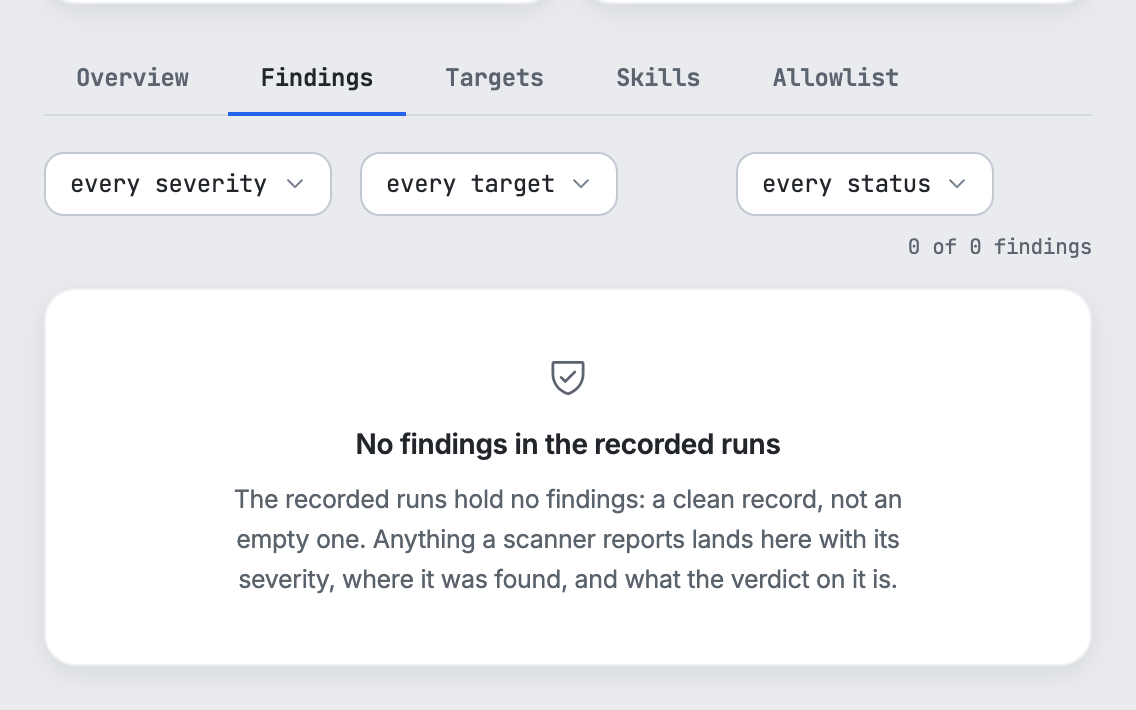
Every finding lands in one table with how bad it is, where it is, and where it stands. A human records the verdict: still open, confirmed, or a false alarm. Nothing marks itself resolved. Findings from tools you already run can be brought in, and they arrive as claims to check rather than answers.
The instructions you give AI agents are scanned too
An AI agent works from an instruction file somebody wrote. Those files are checked for attempts to talk the AI agent out of its rules, keys typed straight into the text, tries at leaving the sandbox, and anything that would quietly stay behind. The check runs when the file is saved, and again before anybody shares it with the rest of the organisation.
Nothing ships on a scan nobody read
A project can require a recent scan before anything goes live. No scan on record and it is refused. A critical or high finding nobody has cleared, and it is refused too, whether the finding came from us or from a tool you already run. Approving a package refreshes the project's parts list at the same moment, so the list never lags the decision.
Bring a repository and watch it scanned end to end.
Also in Governance
- ApprovalsAnything that cannot be undone is assigned to a human.Read the page
- Audit trail and evidenceWho did what, on a sealed record, exported when someone asks.Read the page
- AI agent securityA name, a limit, and somebody who can stop it.Read the page
- AI agent identityA human lets an AI agent in, and can stop it again.Read the page
- What an AI agent may doIt never reaches further than the human it works for.Read the page
- AI agent sign-insA sign-in expires sooner the more it can do.Read the page
- Approved modelsWhich models may run, who approved each one, and what it left behind.Read the page